Devices & Components
Arduino Uno Rev3
Software & Tools
Arduino IDE
Project description
Code
Collatz Conjecture
c_cpp
A short C++ program to produce Collatz sequences for any given positive integer.
1// 2// Ron Bentley, Stafford UK 3// November 2021 4// 5// This example and code is in the public domain and may be used without 6// restriction and without warranty. 7// 8// Collatz Conjecture 9// ^^^^^^^^^^^^^^^^^^ 10// 11// A sketch to produce the Collatz sequence for a given positive integer. 12// The Collatz sequence for any positive integer, N, is determined as follows: 13// 14// if N is odd set N = 3*N + 1 (which will then be even) 15// if N is even set N = N/2 (which will be either be an odd or an even number) 16// repeat the above until N converges to 1, ie N = 1. 17// 18// For any given positive integer the Collatz squence will always converge to 1, although 19// this remains unproven. The Collatz conjecture is also know as the 3N+1 conjecture. 20// 21 22uint32_t collatz_num; // the positive integer for which the Collatz sequence will be determined 23 24// 25// The function implements/executes the Collatz 'rules' to determine the Collatz 26// sequence for the given positive integer. 27// The function prints each number in the Collatz sequence to the currently 28// selected output stream - the serial monitor ot the serial polotter. 29// 30void collatz(uint32_t collatz_num) { 31 uint16_t convergence_steps; // records the number of steps performed before the Collatz sequence reaches 1 32 convergence_steps = 0; // count of the number of steps to convergence 33 Serial.print("\ 34Collatz sequence for "); 35 Serial.print(collatz_num); 36 Serial.println("..."); 37 // apply the Collatz rules 38 while (collatz_num > 1) { 39 convergence_steps++; 40 Serial.println(collatz_num); 41 if (collatz_num & 1 == 1) {// test bottom bit 42 // odd number 43 collatz_num = collatz_num * 3 + 1; 44 } else 45 { 46 // even number 47 collatz_num = collatz_num >> 1; // divide by 2 48 } 49 } 50 // done, we have reached convergence (1) 51 convergence_steps++; 52 Serial.println(collatz_num); // final value in the Collatz sequence, which will be 1 53 Serial.print("Collatz convergence steps = "); 54 Serial.println(convergence_steps); 55 Serial.flush(); 56} 57 58uint32_t read_collatz_num() { 59 int32_t collatz_num = 0; 60 while (!Serial.available()); // wait for input 61 while (collatz_num <= 0) { 62 collatz_num = Serial.parseInt(); // read next +ve integer in the current input stream 63 } 64 // input is a positive integer, now flush out any following chars 65 delay(50); // this shouldnt be necessary but it is! 66 while (Serial.available() > 0) { 67 // still more chars in the input stream so read and discard 68 Serial.read(); 69 } 70 return collatz_num; // return the integer read 71} 72 73void setup() { 74 Serial.begin(9600); 75 Serial.println("Collatz Conjecture Examples"); 76 Serial.println("^^^^^^^^^^^^^^^^^^^^^^^^^^^"); 77 Serial.println("Enter any positive integer and press return/send"); 78} 79 80void loop() { 81 // keep reading user supplied values and determine their Collatz sequences 82 do { 83 collatz_num = read_collatz_num(); // read user input 84 collatz(collatz_num); 85 } while (true); 86} 87
Downloadable files
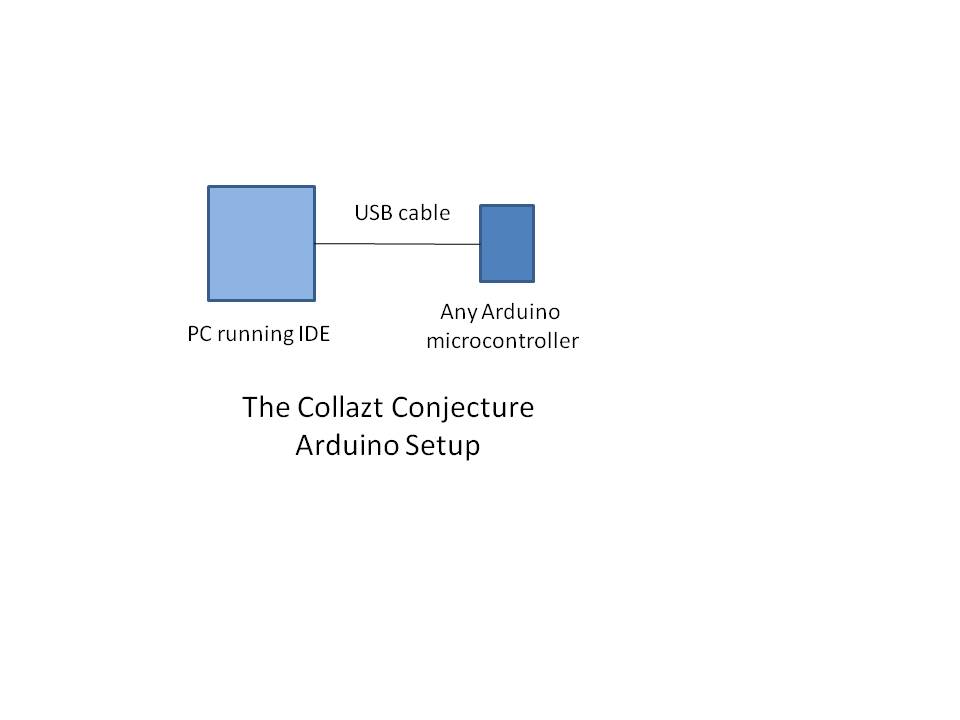
Collatz Conject Hardware Setup
Simple Configuration for Producing Collatz Sequences
Collatz Conject Hardware Setup
Comments
Only logged in users can leave comments