ESP32 Analog VU Meter – Smooth Needle, Real Audio Response (DIY Build)
In this project, I built a fully functional analog-style VU meter using an CrowPanel 3.5"-HMI ESP32 display, and LVGL.
Devices & Components
4
Resistor 100k _1206
2
Resistor 1k ohm
2
10uF Capacitor
2
Resistor 220 ohm
2
LED(Light Emitting Diode) White,Green,Red,Yellow,Blue Color
2
CrowPanel 3.5"-HMI ESP32 Display 480x320
Hardware & Tools
1
Soldering Iron Kit
Software & Tools

Arduino IDE
Project description
Code
Code
cpp
...
1// by mircemk April, 2026
2
3#include <Arduino.h>
4#include <lvgl.h>
5#include <TFT_eSPI.h>
6#include "ui.h"
7
8#define SCREEN_WIDTH   480
9#define SCREEN_HEIGHT  320
10
11#define AUDIO_PIN      35
12
13// --------------------------------------------------
14// Peak LED settings
15// --------------------------------------------------
16#define PEAK_LED_PIN         21
17#define PEAK_HOLD_MS         120
18#define PEAK_ANGLE_THRESHOLD 270
19
20// --------------------------------------------------
21// Backlight PWM settings
22// --------------------------------------------------
23#define TFT_BL        27
24#define BL_CHANNEL    0
25#define BL_FREQ       5000
26#define BL_RESOLUTION 8      // 0-255
27#define BL_LEVEL      155    // <-- ova doteraj go za sekoj displej posebno
28
29// --------------------------------------------------
30// TFT + LVGL
31// --------------------------------------------------
32TFT_eSPI tft = TFT_eSPI();
33
34static lv_disp_draw_buf_t draw_buf;
35static lv_color_t *buf1 = nullptr;
36static lv_color_t *buf2 = nullptr;
37
38// --------------------------------------------------
39// VU meter variables
40// --------------------------------------------------
41float smoothed_val = 0.01f;
42
43int adcMin = 120;
44int adcMax = 1000;
45
46int16_t meterAngleMin = -400;
47int16_t meterAngleMax =  400;
48
49int16_t current_angle = 0;
50uint32_t last_update = 0;
51uint32_t peakTimer = 0;
52
53// --------------------------------------------------
54// LVGL flush
55// --------------------------------------------------
56void my_disp_flush(lv_disp_drv_t *disp, const lv_area_t *area, lv_color_t *color_p)
57{
58    uint32_t w = (area->x2 - area->x1 + 1);
59    uint32_t h = (area->y2 - area->y1 + 1);
60
61    tft.startWrite();
62    tft.setAddrWindow(area->x1, area->y1, w, h);
63    tft.pushColors((uint16_t *)&color_p->full, w * h, true);
64    tft.endWrite();
65
66    lv_disp_flush_ready(disp);
67}
68
69// --------------------------------------------------
70// Intro screen
71// --------------------------------------------------
72void showIntroText()
73{
74    tft.fillScreen(TFT_BLACK);
75    tft.setTextDatum(MC_DATUM);
76    tft.setTextColor(TFT_WHITE, TFT_BLACK);
77
78    tft.setTextFont(4);
79    tft.drawCentreString("VU - Meter", SCREEN_WIDTH / 2, 95, 4);
80    tft.drawCentreString("by", SCREEN_WIDTH / 2, 145, 4);
81    tft.drawCentreString("mircemk", SCREEN_WIDTH / 2, 190, 4);
82    delay(1800);
83}
84
85// --------------------------------------------------
86// Read audio
87// --------------------------------------------------
88int readVuLevel()
89{
90    const int samples = 16;
91    int minVal = 1700;
92    int maxVal = 0;
93
94    for (int i = 0; i < samples; i++) {
95        int v = analogRead(AUDIO_PIN);
96        if (v < minVal) minVal = v;
97        if (v > maxVal) maxVal = v;
98    }
99
100    int peakToPeak = maxVal - minVal;
101
102    const float attackCoeff  = 0.20f;
103    const float releaseCoeff = 0.20f;
104
105    if (peakToPeak > smoothed_val) {
106        smoothed_val = peakToPeak * attackCoeff + smoothed_val * (1.0f - attackCoeff);
107    } else {
108        smoothed_val = peakToPeak * releaseCoeff + smoothed_val * (1.0f - releaseCoeff);
109    }
110
111    return (int)smoothed_val;
112}
113
114// --------------------------------------------------
115// Setup needle
116// --------------------------------------------------
117void setupNeedle()
118{
119    if (ui_Image2 == NULL) return;
120
121    const int needlePivotX = 6;
122    const int needlePivotY = 300;
123    const int needleX = 0;
124    const int needleY = -10;
125
126    lv_img_set_pivot(ui_Image2, needlePivotX, needlePivotY);
127    lv_obj_set_pos(ui_Image2, needleX, needleY);
128    lv_img_set_angle(ui_Image2, 0);
129
130    Serial.printf("needle x=%d y=%d\n", lv_obj_get_x(ui_Image2), lv_obj_get_y(ui_Image2));
131    Serial.printf("parent w=%d h=%d\n",
132                  lv_obj_get_width(lv_obj_get_parent(ui_Image2)),
133                  lv_obj_get_height(lv_obj_get_parent(ui_Image2)));
134}
135
136// --------------------------------------------------
137// Arduino setup
138// --------------------------------------------------
139void setup()
140{
141    Serial.begin(115200);
142    delay(300);
143
144    analogReadResolution(12);
145    pinMode(AUDIO_PIN, INPUT);
146
147    pinMode(PEAK_LED_PIN, OUTPUT);
148    digitalWrite(PEAK_LED_PIN, LOW);   // LED OFF
149
150
151
152    tft.begin();
153    tft.setRotation(1);
154    tft.fillScreen(TFT_BLACK);
155
156        // Backlight PWM
157    ledcSetup(BL_CHANNEL, BL_FREQ, BL_RESOLUTION);
158    ledcAttachPin(TFT_BL, BL_CHANNEL);
159    ledcWrite(BL_CHANNEL, BL_LEVEL);
160
161    showIntroText();
162
163    lv_init();
164
165    const uint32_t buf_pixels = SCREEN_WIDTH * 100;
166    buf1 = (lv_color_t *)heap_caps_malloc(buf_pixels * sizeof(lv_color_t), MALLOC_CAP_DMA);
167    buf2 = (lv_color_t *)heap_caps_malloc(buf_pixels * sizeof(lv_color_t), MALLOC_CAP_DMA);
168
169    if (!buf1 || !buf2) {
170        Serial.println("LVGL buffer allocation failed!");
171        while (1) delay(100);
172    }
173
174    lv_disp_draw_buf_init(&draw_buf, buf1, buf2, buf_pixels);
175
176    static lv_disp_drv_t disp_drv;
177    lv_disp_drv_init(&disp_drv);
178    disp_drv.hor_res = SCREEN_WIDTH;
179    disp_drv.ver_res = SCREEN_HEIGHT;
180    disp_drv.flush_cb = my_disp_flush;
181    disp_drv.draw_buf = &draw_buf;
182    lv_disp_drv_register(&disp_drv);
183
184    ui_init();
185    setupNeedle();
186
187    Serial.println("UI initialized.");
188}
189
190// --------------------------------------------------
191// LOOP
192// --------------------------------------------------
193void loop()
194{
195    lv_timer_handler();
196
197    if (millis() - last_update >= 20) {
198        last_update = millis();
199
200        int vuLevel = readVuLevel();
201
202        int16_t target_angle = map(vuLevel, adcMin, adcMax, meterAngleMin, meterAngleMax);
203
204        if (target_angle > meterAngleMax) target_angle = meterAngleMax;
205        if (target_angle < meterAngleMin) target_angle = meterAngleMin;
206
207        lv_img_set_angle(ui_Image2, target_angle);
208        current_angle = target_angle;
209
210        // Peak LED spored realnata pozicija na iglata
211        if (current_angle >= PEAK_ANGLE_THRESHOLD) {
212            digitalWrite(PEAK_LED_PIN, HIGH);   // LED ON
213            peakTimer = millis();
214        }
215        else if (millis() - peakTimer > PEAK_HOLD_MS) {
216            digitalWrite(PEAK_LED_PIN, LOW);    // LED OFF
217        }
218    }
219}
Downloadable files
Libraries
...
Libraries.zip
Code_VU_Final full
...
Code_VU_Final.zip
Documentation
Schematic
...
Schematic.jpg
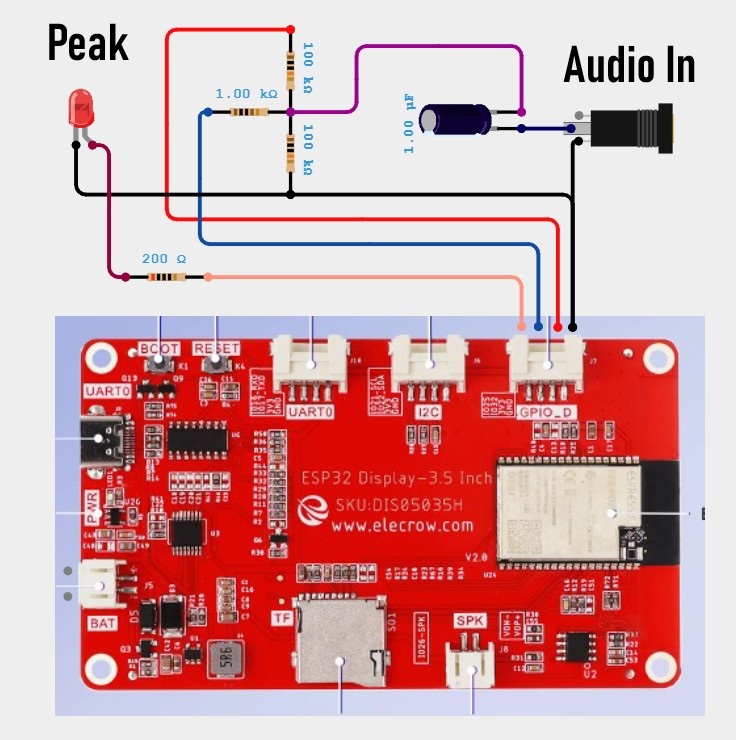
Comments
Only logged in users can leave comments