REFLEXES MACHINE — A Reaction Game That Starts When It Sees You (Arduino UNO Q & 12 Modulinos)
An arcade reaction game that challenges you the moment you walk up to it. A USB camera detects your face and the countdown begins on its own — or you hit Start, if you prefer. Four illuminated arcade buttons, eight Modulino LED Matrix displays running a live stopwatch, and sound effects on the Linux side. Built entirely on the Arduino UNO Q, using both of its brains at once.
Devices & Components
1
Modulino™ Thermo
1
Arduino® UNO™ Q 4GB
8
Modulino™ LED Matrix
4
Modulino™ Pixels
32
Led 3.3V 20mA
4
Transistor NPN S8050
4
Resistor 470Ω
16
Tactile Switch 6x6x4.3mm
1
Speaker USB
1
LiPo battery 11.1V 3S 2200mAh
Hardware & Tools
1
3D printer
Software & Tools
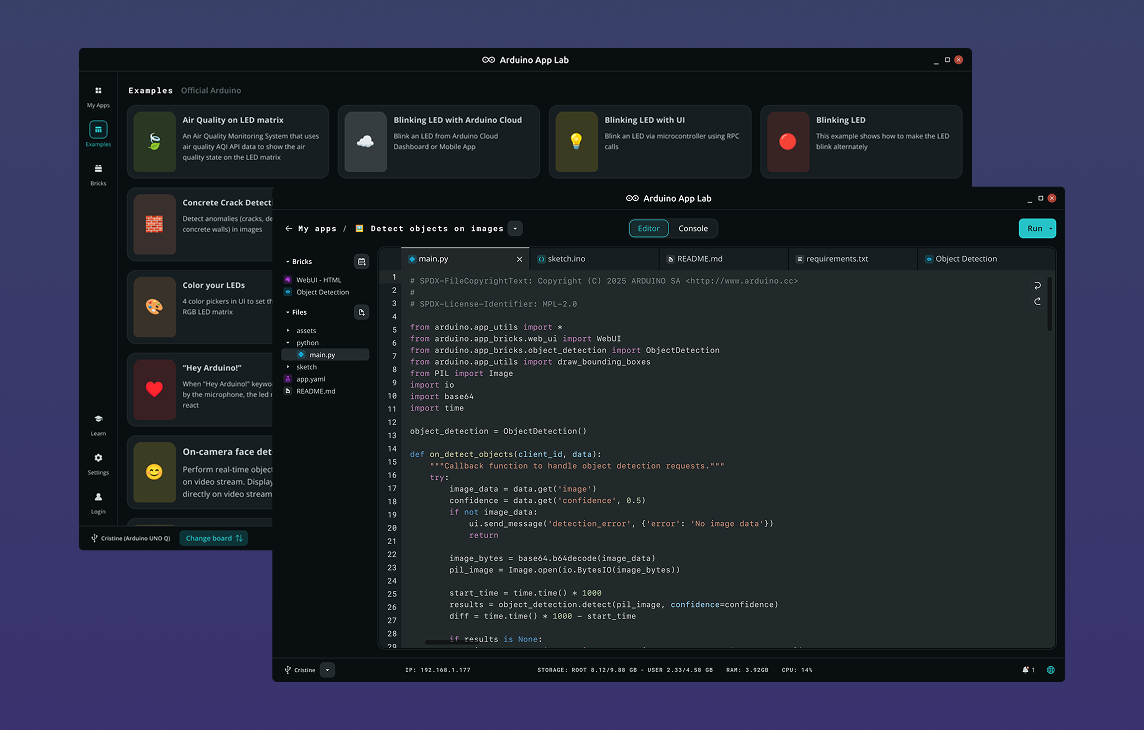
Arduino App Lab
Project description
Code
AddressChanger
cpp
1/*
2 * Modulino - Address Changer
3 *
4 * This utility allows you to change the I2C addresses of Modulino modules.
5 * This is essential when you want to use multiple modules of the same type
6 * on the same I2C bus (e.g., multiple encoders or buttons).
7 *
8 * By default, each Modulino type has a fixed default I2C address. If you connect
9 * two modules of the same type, they will conflict. This tool lets you change
10 * the address to avoid conflicts.
11 *
12 * How to use:
13 * 1. Connect the Arduino and open the Serial Monitor (115200 baud)
14 * 2. The tool will show all detected Modulino devices with their addresses
15 * 3. Enter commands in this format: "current_address new_address"
16 *    Examples:
17 *    - "0x3E 0x3F" - Changes device at 0x3E to address 0x3F
18 *    - "0x3E 0" - Resets device at 0x3E to its default address
19 *    - "0 0" - Resets ALL devices to their default addresses (broadcast)
20 *
21 * IMPORTANT NOTES:
22 * - Valid I2C addresses range from 0x08 to 0x77
23 * - Some devices have fixed addresses and cannot be changed (Distance, Thermo, Movement)
24 * - The new address is stored in the module's memory permanently
25 * - After changing addresses, power cycle the modules to ensure changes take effect
26 *
27 * Default addresses by module type:
28 * - Buzzer: 0x1E (pinstrap 0x3C)
29 * - Joystick: 0x2C (pinstrap 0x58)
30 * - Buttons: 0x3E (pinstrap 0x7C)
31 * - Opto Relay: 0x14 (pinstrap 0x28)
32 * - Encoder: 0x3B or 0x3A (pinstrap 0x76 or 0x74)
33 * - Smartleds: 0x36 (pinstrap 0x6C)
34 * - Vibro: 0x38 (pinstrap 0x70)
35 * - Distance: 0x29 (fixed, cannot change)
36 * - Thermo: 0x44 (fixed, cannot change)
37 * - Movement: 0x6A or 0x6B (fixed, cannot change)
38 *
39 * This example code is in the public domain.
40 * Copyright (c) 2025 Arduino
41 * SPDX-License-Identifier: MPL-2.0
42 */
43
44#include "Wire.h"
45
46// Structure to store information about detected Modulino devices
47struct DetectedModulino {
48  uint8_t addr;           // Current I2C address
49  String modulinoType;    // Type of module (e.g., "Buzzer", "Encoder")
50  String pinstrap;        // Pinstrap value (identifies device type)
51  String defaultAddr;     // Default address for this module type
52};
53
54#define MAX_DEVICES 16
55DetectedModulino rows[MAX_DEVICES];  // Array to store detected devices
56int numRows = 0;  // Number of devices currently detected
57
58
59void setup() {
60  // Initialize I2C communication on Wire1 interface
61  Wire1.begin();
62  // Initialize serial communication at 115200 baud
63  Serial.begin(115200);
64
65  // Wait for serial port to initialize
66  while (!Serial) {};
67
68  // Scan I2C bus and display all detected Modulino devices
69  discoverDevices();
70}
71
72bool waitingInput = false;
73
74void loop() {
75  // If no devices detected, nothing to do
76  if (numRows == 0) return;
77  // If waiting for input and nothing available, keep waiting
78  if (Serial.available() == 0 && waitingInput) return;
79
80  // Process user input when available
81  if (Serial.available() > 0) {
82    // Read two hexadecimal values separated by space
83    String hex1 = Serial.readStringUntil(' ');   // Current address
84    String hex2 = Serial.readStringUntil('\n');  // New address
85    // Echo back what user entered
86    Serial.println("> " + hex1 + " " + hex2);
87
88    // Parse the hexadecimal strings to integer values
89    int num1 = parseHex(hex1);  // Current address
90    int num2 = parseHex(hex2);  // New address
91
92    // Validate input
93    if (num1 == -1 || num2 == -1) {
94      Serial.println("Error: Incomplete or invalid input. Please enter two hexadecimal numbers");
95      return;
96    }
97
98    // Attempt to update the I2C address
99    bool success = updateI2cAddress(num1, num2);
100    if (!success) return;  // If update failed, wait for new input
101
102    // Re-scan devices to show updated addresses
103    discoverDevices();
104    waitingInput = false;
105  }
106
107  // Display instructions for the user
108  Serial.println("Enter the current address, space, and new address (ex. \"0x20 0x30\" or \"20 2A\"):");
109  Serial.println("  - Enter \"<addr> 0\" to reset the device at <addr> to its default address.");
110  Serial.println("  - Enter \"0 0\" to reset all devices to the default address.");
111  waitingInput = true;
112}
113
114// Updates the device at current address to new address. Supports broadcasting and setting default address (0).
115// Returns true if the update was successful, false otherwise.
116bool updateI2cAddress(int curAddress, int newAddress) {
117  uint8_t data[48] = { 'C', 'F', newAddress * 2 };
118  memset(data + 3, 0, sizeof(data) - 3);  // Zero the rest of the buffer.
119
120  // Validate the current address, it must match a detected device.
121  if (curAddress != 0 && !findRow(curAddress)) {
122    Serial.println("Error: current address 0x" + String(curAddress, HEX) + " not found in the devices list\n");
123    return false;
124  }
125
126  if (curAddress != 0 && isFixedAddrDevice(curAddress)) {
127    Serial.println("Error: address 0x" + String(curAddress, HEX) + " is a non configurable device\n");
128    return false;
129  }
130
131  // Validate the new address.
132  if (newAddress != 0 && (newAddress < 8 || newAddress > 0x77)) {
133    Serial.println("Error: new address 0x" + String(newAddress, HEX) + " must be from 0x08 to 0x77\n");
134    return false;
135  }
136
137  if (curAddress == 0) {
138    Serial.print("Updating all devices (broadcast 0x00) to 0x" + String(newAddress, HEX));
139  } else {
140    Serial.print("Updating the device address from 0x" + String(curAddress, HEX) + " to 0x" + String(newAddress, HEX));
141  }
142  if (newAddress == 0) Serial.print(" (default address)");
143  Serial.print("...");
144
145  Wire1.beginTransmission(curAddress);
146  Wire1.write(data, 40);
147  Wire1.endTransmission();
148
149  delay(500);
150
151  if (newAddress == 0) {
152    Serial.println(" done\n");
153    return true;
154  } else {
155    Wire1.requestFrom(newAddress, 1);
156    if (Wire1.available()) {
157      Serial.println(" done\n");
158      return true;
159    } else {
160      Serial.println(" error\n");
161      return false;
162    }
163  }
164}
165
166// Function to parse hex number (with or without 0x prefix)
167int parseHex(String hexStr) {
168  hexStr.trim();
169
170  if (hexStr.length() == 0) {
171    return -1;
172  }
173
174  if (hexStr.startsWith("0x") || hexStr.startsWith("0X")) {
175    hexStr = hexStr.substring(2);  // Remove the "0x" prefix
176  }
177
178  // Validate that the remaining string contains only valid hexadecimal characters (0-9, A-F, a-f)
179  for (int i = 0; i < hexStr.length(); i++) {
180    if (!isHexDigit(hexStr.charAt(i))) {
181      return -1;
182    }
183  }
184
185  return strtol(hexStr.c_str(), NULL, 16);
186}
187
188bool isHexDigit(char c) {
189  return ((c >= '0' && c <= '9') || (c >= 'A' && c <= 'F') || (c >= 'a' && c <= 'f'));
190}
191
192void discoverDevices() {
193  char buffer[64];
194  Serial.println("ADDR\tMODULINO\tPINSTRAP\tDEFAULT ADDR");  // Table heading.
195
196  numRows = 0;
197
198  // Discover all modulino devices connected to the I2C bus.
199  for (int addr = 0; addr < 128; addr++) {
200    Wire1.beginTransmission(addr);
201    if (Wire1.endTransmission() != 0) continue;
202
203    if (numRows >= MAX_DEVICES) {
204      Serial.println("Too many devices connected, maximum supported is" + String(MAX_DEVICES));
205      return;
206    }
207
208    // Some addresses represent non configurable devices (no MCU on it). Handle them as a special case.
209    if (isFixedAddrDevice(addr)) {
210      snprintf(buffer, 64, "0x%02X (cannot change)", addr);
211      addRow(addr, fixedAddrToName(addr), "-", String(buffer));
212
213      continue;  // Stop here, do not try to communicate with this device.
214    }
215
216    {
217      uint8_t pinstrap = 0;           // Variable to store the pinstrap (device type)
218      Wire1.beginTransmission(addr);  // Begin I2C transmission to the current address
219      Wire1.write(0x00);              // Send a request to the device (assuming 0x00 is the register for device type)
220      Wire1.endTransmission();        // End transmission
221
222      delay(50);  // Delay to allow for the device to respond
223
224      Wire1.requestFrom(addr, 1);  // Request 1 byte from the device at the current address
225      if (Wire1.available()) {
226        pinstrap = Wire1.read();  // Read the device type (pinstrap)
227      } else {
228        // If an error happens in the range 0x78 to 0x7F, ignore it.
229        if (addr >= 0x78) continue;
230        Serial.println("Failed to read device type at address 0x" + String(addr, HEX));
231      }
232
233      snprintf(buffer, 64, "0x%02X", pinstrap);
234      auto hexPinstrap = String(buffer);
235
236      snprintf(buffer, 64, "0x%02X", pinstrap / 2);  // Default address is half pinstrap.
237      auto defaultAddr = String(buffer);
238      if (addr != pinstrap / 2) defaultAddr += " *";  // Mark devices with modified address.
239
240      addRow(addr, pinstrapToName(pinstrap), hexPinstrap, defaultAddr);
241    }
242  }
243
244  // Print the results.
245  for (int i = 0; i < numRows; i++) {
246    char buffer[16];
247    snprintf(buffer, 16, "0x%02X", rows[i].addr);
248
249    Serial.print(fixedWidth(buffer, 8));
250    Serial.print(fixedWidth(rows[i].modulinoType, 16));
251    Serial.print(fixedWidth(rows[i].pinstrap, 16));
252    Serial.println(fixedWidth(rows[i].defaultAddr, 12));
253  }
254}
255
256void addRow(uint8_t address, String modulinoType, String pinstrap, String defaultAddr) {
257  if (numRows >= MAX_DEVICES) return;
258
259  rows[numRows].addr = address;
260  rows[numRows].modulinoType = modulinoType;
261  rows[numRows].pinstrap = pinstrap;
262  rows[numRows].defaultAddr = defaultAddr;
263  numRows++;  // Increment the row counter
264}
265
266bool findRow(uint8_t address) {
267  for (int i = 0; i < numRows; i++) {
268    if (rows[i].addr == address) return true;
269  }
270  return false;
271}
272
273
274// Function to add padding to the right to ensure each field has a fixed width
275String fixedWidth(String str, int width) {
276  for (int i = str.length(); i < width; i++) str += ' ';
277  return str;
278}
279
280String pinstrapToName(uint8_t pinstrap) {
281  switch (pinstrap) {
282    case 0x04:
283      return "Latch Relay";
284    case 0x3C:
285      return "Buzzer";
286    case 0x58:
287      return "Joystick";
288    case 0x7C:
289      return "Buttons";
290    case 0x28:
291      return "Opto Relay";
292    case 0x76:
293    case 0x74:
294      return "Encoder";
295    case 0x6C:
296      return "Smartleds";
297    case 0x70:
298      return "Vibro";
299    case 0x48:
300      return "Motors";
301  }
302  return "UNKNOWN";
303}
304
305String fixedAddrToName(uint8_t address) {
306  switch (address) {
307    case 0x29:
308      return "Distance";
309    case 0x44:
310      return "Thermo";
311    case 0x6A:
312    case 0x6B:
313      return "Movement";
314  }
315  return "UNKNOWN";
316}
317
318bool isFixedAddrDevice(uint8_t addr) {
319  // List of non-configurable devices, recognized by their fixed I2C address.
320  const uint8_t fixedAddr[] = { 0x29, 0x44, 0x6A, 0x6B };
321
322  for (int i = 0; i < sizeof(fixedAddr) / sizeof(fixedAddr[0]); i++) {
323    if (addr == fixedAddr[i]) return true;
324  }
325  return false;
326}
TestReflexesMachine
1/*
2 * Modulino Bus Test  —  Arduino UNO Q
3 * ---------------------------------------------------------------
4 * Verifica tutti i moduli sul bus Qwiic (Wire1):
5 *   - 4x Pixels     @ 0x50 0x51 0x52 0x53   (punto mobile, colore diverso per strip)
6 *   - 8x LED Matrix @ 0x54 ... 0x5B          (ogni matrice mostra il proprio address)
7 *   - 1x Thermo     @ 0x44 (fisso)           (temp + umidita' su Serial)
8 *
9 * Il check di presenza reale e' un ping I2C diretto su Wire1:
10 * begin() con address esplicito non scansiona il bus.
11 *
12 * Serial Monitor @ 115200.
13 */
14
15#include <Wire.h>
16#include <Arduino_Modulino.h>
17#include <Modulino_LED_Matrix.h>
18
19// ---------------- moduli ----------------
20ModulinoPixels px[4] = {
21  ModulinoPixels(0x50), ModulinoPixels(0x51),
22  ModulinoPixels(0x52), ModulinoPixels(0x53)
23};
24const uint8_t pxAddr[4] = { 0x50, 0x51, 0x52, 0x53 };
25
26ModulinoLEDMatrix mtx[8] = {
27  ModulinoLEDMatrix(0x54), ModulinoLEDMatrix(0x55),
28  ModulinoLEDMatrix(0x56), ModulinoLEDMatrix(0x57),
29  ModulinoLEDMatrix(0x58), ModulinoLEDMatrix(0x59),
30  ModulinoLEDMatrix(0x5A), ModulinoLEDMatrix(0x5B)
31};
32const uint8_t mtxAddr[8] = { 0x54,0x55,0x56,0x57,0x58,0x59,0x5A,0x5B };
33
34ModulinoThermo thermo;   // 0x44 fisso, nessun address nel costruttore
35
36// colore distinto per ognuna delle 4 strip Pixels
37const ModulinoColor pxColor[4] = {
38  ModulinoColor(255,   0,   0),   // 0x50 rosso
39  ModulinoColor(  0, 255,   0),   // 0x51 verde
40  ModulinoColor(  0,   0, 255),   // 0x52 blu
41  ModulinoColor(255, 160,   0)    // 0x53 ambra
42};
43
44// ------------- font hex 3x5 (bit2 = colonna sinistra) -------------
45const uint8_t FONT[16][5] = {
46  {0b111,0b101,0b101,0b101,0b111}, // 0
47  {0b010,0b110,0b010,0b010,0b111}, // 1
48  {0b111,0b001,0b111,0b100,0b111}, // 2
49  {0b111,0b001,0b111,0b001,0b111}, // 3
50  {0b101,0b101,0b111,0b001,0b001}, // 4
51  {0b111,0b100,0b111,0b001,0b111}, // 5
52  {0b111,0b100,0b111,0b101,0b111}, // 6
53  {0b111,0b001,0b010,0b010,0b010}, // 7
54  {0b111,0b101,0b111,0b101,0b111}, // 8
55  {0b111,0b101,0b111,0b001,0b111}, // 9
56  {0b111,0b101,0b111,0b101,0b101}, // A
57  {0b110,0b101,0b110,0b101,0b110}, // B
58  {0b111,0b100,0b100,0b100,0b111}, // C
59  {0b110,0b101,0b101,0b101,0b110}, // D
60  {0b111,0b100,0b111,0b100,0b111}, // E
61  {0b111,0b100,0b111,0b100,0b100}  // F
62};
63
64// scrive una cifra hex (3x5) nella griglia [riga][colonna] a partire da (xOff, yOff)
65// grid[y][x] = 1 -> LED acceso
66void drawGlyph(uint8_t grid[8][12], uint8_t nibble, uint8_t xOff, uint8_t yOff) {
67  for (uint8_t r = 0; r < 5; r++) {
68    uint8_t bits = FONT[nibble & 0x0F][r];
69    for (uint8_t c = 0; c < 3; c++) {
70      if (bits & (1 << (2 - c))) grid[yOff + r][xOff + c] = 1;
71    }
72  }
73}
74
75// mostra il byte come 2 cifre hex, centrato sulla matrice 12x8
76void showAddr(ModulinoLEDMatrix &m, uint8_t value) {
77  uint8_t grid[8][12] = {{0}};
78  drawGlyph(grid, value >> 4,   2, 1);   // cifra alta -> colonne 2..4
79  drawGlyph(grid, value & 0x0F, 6, 1);   // cifra bassa -> colonne 6..8
80
81  // converti in frame da 12 byte, layout MonochromaticVertical (default libreria):
82  // per ogni pixel acceso (riga y, colonna x) -> frame[x] |= (1 << y)
83  uint8_t frame[12] = {0};
84  for (uint8_t y = 0; y < 8; y++)
85    for (uint8_t x = 0; x < 12; x++)
86      if (grid[y][x]) frame[x] |= (1 << y);
87
88  m.setFrame(frame);
89}
90
91// ping I2C diretto: check di presenza affidabile sul bus Wire1
92bool present(uint8_t addr) {
93  Wire1.beginTransmission(addr);
94  return (Wire1.endTransmission() == 0);
95}
96
97void report(const char* label, uint8_t addr, bool ok) {
98  Serial.print(label);
99  Serial.print(" 0x");
100  if (addr < 0x10) Serial.print('0');
101  Serial.print(addr, HEX);
102  Serial.println(ok ? "   [OK]" : "   [--- ASSENTE]");
103}
104
105void setup() {
106  Serial.begin(115200);
107  while (!Serial) {}
108  Modulino.begin();   // inizializza Wire1 (bus Modulino su UNO Q)
109
110  Serial.println("\n===== Modulino bus test =====");
111
112  // Pixels
113  for (int i = 0; i < 4; i++) {
114    px[i].begin();
115    report("Pixels", pxAddr[i], present(pxAddr[i]));
116  }
117
118  // LED Matrix: init + scrivi l'address sulla matrice se presente
119  for (int i = 0; i < 8; i++) {
120    mtx[i].begin();
121    bool ok = present(mtxAddr[i]);
122    report("Matrix", mtxAddr[i], ok);
123    if (ok) showAddr(mtx[i], mtxAddr[i]);
124  }
125
126  // Thermo (begin() init davvero il sensore)
127  bool okT = thermo.begin();
128  report("Thermo", 0x44, okT);
129
130  Serial.println("=============================\n");
131}
132
133void loop() {
134  static uint8_t dot = 0;
135
136  // punto mobile su ogni strip Pixels, colore per strip
137  for (int i = 0; i < 4; i++) {
138    px[i].clear();
139    px[i].set(dot % 8, pxColor[i], 40);   // brightness 0..100
140    px[i].show();
141  }
142  dot++;
143
144  // lettura Thermo (solo se init ok)
145  if (thermo) {
146    Serial.print("T: ");  Serial.print(thermo.getTemperature(), 1);
147    Serial.print(" C   RH: "); Serial.print(thermo.getHumidity(), 0);
148    Serial.println(" %");
149  }
150
151  delay(200);
152}
Arduino App Lab
reflexes
😀
reflexes
Downloadable files
reflexes_machine
reflexes_machine.zip
Documentation
REFLEXES MACHINE BUILD
REFLEXES MACHINE BUILD.pdf
reflexes_bom
reflexes_bom.pdf
Comments
Only logged in users can leave comments