Homemade Pulse Oximetry Display (The H-P.O.D.)
A convenient way of measuring BPM and blood-oxygen saturation levels (SPO2) from the comfort of your own home.
Devices & Components
1
16x2 LCD display with I²C interface
1
Arduino Uno Rev3
1
MAX30102 High-Sensitivity Pulse Oximeter and Heart-Rate Sensor for Wearable Health
1
Breadboard (generic)
Hardware & Tools
1
Soldering iron (generic)
Software & Tools

Arduino IDE
Project description
Code
The Code
arduino
1/*!
2* @file SPO2.ino
3* @brief Display heart-rate and SPO2 on serial  in real-time, normal SPO2 is within 95~100
4* @n Try to fix the sensor on your  finger in using to avoid the effect of pressure change on data output.
5* @n This  library supports mainboards: ESP8266, FireBeetle-M0, UNO, ESP32, Leonardo, Mega2560
6*  @copyright  Copyright (c) 2010 DFRobot Co.Ltd (http://www.dfrobot.com)
7* @licence     The MIT License (MIT)
8* @author [YeHangYu](hangyu.ye@dfrobot.com)
9* @version  V0.1
10* @date  2020-05-29
11* @url https://github.com/DFRobot/DFRobot_MAX30102
12*/
13#include  <DFRobot_MAX30102.h>
14DFRobot_MAX30102 particleSensor;
15/*
16Macro definition  options in sensor configuration
17sampleAverage: SAMPLEAVG_1 SAMPLEAVG_2 SAMPLEAVG_4
18             SAMPLEAVG_8 SAMPLEAVG_16 SAMPLEAVG_32
19ledMode:       MODE_REDONLY  MODE_RED_IR  MODE_MULTILED
20sampleRate:    PULSEWIDTH_69 PULSEWIDTH_118 PULSEWIDTH_215  PULSEWIDTH_411
21pulseWidth:    SAMPLERATE_50 SAMPLERATE_100 SAMPLERATE_200 SAMPLERATE_400
22             SAMPLERATE_800 SAMPLERATE_1000 SAMPLERATE_1600 SAMPLERATE_3200
23adcRange:      ADCRANGE_2048 ADCRANGE_4096 ADCRANGE_8192 ADCRANGE_16384
24*/
25#include  <Wire.h>
26#include <LCD_I2C.h>
27LCD_I2C lcd(0x27); // Default address of most  PCF8574 modules, change according
28
29
30void setup()
31{
32 lcd.begin();  // If you are using more I2C devices using the Wire library use lcd.begin(false)
33                // this stop the library(LCD_I2C) from calling Wire.begin()
34   lcd.backlight();
35   lcd.home();
36    lcd.clear();
37Serial.begin(9600);
38/*!
39  *@brief Init sensor
40 *@param pWire IIC bus pointer object and construction device,  can both pass or not pass parameters (Wire in default)
41 *@param i2cAddr Chip  IIC address (0x57 in default)
42 *@return true or false
43 */
44while (!particleSensor.begin())  {
45  //lcd.println("MAX30102 was not found");
46  delay(1000);
47}
48/*!
49  *@brief Use macro definition to configure sensor
50 *@param ledBrightness LED brightness,  default value: 0x1F(6.4mA), Range: 0~255(0=Off, 255=50mA)
51 *@param sampleAverage  Average multiple samples then draw once, reduce data throughput, default 4 samples  average
52 *@param ledMode LED mode, default to use red light and IR at the same  time
53 *@param sampleRate Sampling rate, default 400 samples every second
54  *@param pulseWidth Pulse width: the longer the pulse width, the wider the detection  range. Default to be Max range
55 *@param adcRange ADC Measurement Range, default  4096 (nA), 15.63(pA) per LSB
56 */
57particleSensor.sensorConfiguration(/*ledBrightness=*/50,  /*sampleAverage=*/SAMPLEAVG_4, \\
58                      /*ledMode=*/MODE_MULTILED,  /*sampleRate=*/SAMPLERATE_100, \\
59                      /*pulseWidth=*/PULSEWIDTH_411,  /*adcRange=*/ADCRANGE_16384);
60}
61
62int32_t SPO2; //SPO2
63int8_t  SPO2Valid; //Flag to display if SPO2 calculation is valid
64int32_t heartRate;  //Heart-rate
65int8_t heartRateValid; //Flag to display if heart-rate calculation  is valid
66
67void loop()
68{
69 particleSensor.heartrateAndOxygenSaturation(/**SPO2=*/&SPO2,  /**SPO2Valid=*/&SPO2Valid, /**heartRate=*/&heartRate, /**heartRateValid=*/&heartRateValid);
70  lcd.setCursor(1,0);
71 lcd.print("BPM: ");
72 lcd.print(heartRate, DEC);
73  lcd.print(" ");
74 lcd.print(" ");
75
76lcd.setCursor(0, 1);
77if (heartRateValid  == 1){
78lcd.print(F("SPO2: "));
79lcd.print(SPO2, DEC);
80} else if (heartRateValid  == 0) {
81lcd.print(F("SPO2: 0"));
82lcd.print("%");
83
84}
85 delay(10);
86}
The Code
arduino
1/*!
2* @file SPO2.ino
3* @brief Display heart-rate and SPO2 on serial
4  in real-time, normal SPO2 is within 95~100
5* @n Try to fix the sensor on your
6  finger in using to avoid the effect of pressure change on data output.
7* @n This
8  library supports mainboards: ESP8266, FireBeetle-M0, UNO, ESP32, Leonardo, Mega2560
9*
10  @copyright  Copyright (c) 2010 DFRobot Co.Ltd (http://www.dfrobot.com)
11* @licence
12     The MIT License (MIT)
13* @author [YeHangYu](hangyu.ye@dfrobot.com)
14* @version
15  V0.1
16* @date  2020-05-29
17* @url https://github.com/DFRobot/DFRobot_MAX30102
18*/
19#include
20  <DFRobot_MAX30102.h>
21DFRobot_MAX30102 particleSensor;
22/*
23Macro definition
24  options in sensor configuration
25sampleAverage: SAMPLEAVG_1 SAMPLEAVG_2 SAMPLEAVG_4
26
27             SAMPLEAVG_8 SAMPLEAVG_16 SAMPLEAVG_32
28ledMode:       MODE_REDONLY
29  MODE_RED_IR  MODE_MULTILED
30sampleRate:    PULSEWIDTH_69 PULSEWIDTH_118 PULSEWIDTH_215
31  PULSEWIDTH_411
32pulseWidth:    SAMPLERATE_50 SAMPLERATE_100 SAMPLERATE_200 SAMPLERATE_400
33
34             SAMPLERATE_800 SAMPLERATE_1000 SAMPLERATE_1600 SAMPLERATE_3200
35adcRange:
36      ADCRANGE_2048 ADCRANGE_4096 ADCRANGE_8192 ADCRANGE_16384
37*/
38#include
39  <Wire.h>
40#include <LCD_I2C.h>
41LCD_I2C lcd(0x27); // Default address of most
42  PCF8574 modules, change according
43
44
45void setup()
46{
47 lcd.begin();
48  // If you are using more I2C devices using the Wire library use lcd.begin(false)
49
50                // this stop the library(LCD_I2C) from calling Wire.begin()
51
52   lcd.backlight();
53   lcd.home();
54    lcd.clear();
55Serial.begin(9600);
56/*!
57
58  *@brief Init sensor
59 *@param pWire IIC bus pointer object and construction device,
60  can both pass or not pass parameters (Wire in default)
61 *@param i2cAddr Chip
62  IIC address (0x57 in default)
63 *@return true or false
64 */
65while (!particleSensor.begin())
66  {
67  //lcd.println("MAX30102 was not found");
68  delay(1000);
69}
70/*!
71
72  *@brief Use macro definition to configure sensor
73 *@param ledBrightness LED brightness,
74  default value: 0x1F(6.4mA), Range: 0~255(0=Off, 255=50mA)
75 *@param sampleAverage
76  Average multiple samples then draw once, reduce data throughput, default 4 samples
77  average
78 *@param ledMode LED mode, default to use red light and IR at the same
79  time
80 *@param sampleRate Sampling rate, default 400 samples every second
81
82  *@param pulseWidth Pulse width: the longer the pulse width, the wider the detection
83  range. Default to be Max range
84 *@param adcRange ADC Measurement Range, default
85  4096 (nA), 15.63(pA) per LSB
86 */
87particleSensor.sensorConfiguration(/*ledBrightness=*/50,
88  /*sampleAverage=*/SAMPLEAVG_4, \\
89                      /*ledMode=*/MODE_MULTILED,
90  /*sampleRate=*/SAMPLERATE_100, \\
91                      /*pulseWidth=*/PULSEWIDTH_411,
92  /*adcRange=*/ADCRANGE_16384);
93}
94
95int32_t SPO2; //SPO2
96int8_t
97  SPO2Valid; //Flag to display if SPO2 calculation is valid
98int32_t heartRate;
99  //Heart-rate
100int8_t heartRateValid; //Flag to display if heart-rate calculation
101  is valid
102
103void loop()
104{
105 particleSensor.heartrateAndOxygenSaturation(/**SPO2=*/&SPO2,
106  /**SPO2Valid=*/&SPO2Valid, /**heartRate=*/&heartRate, /**heartRateValid=*/&heartRateValid);
107
108  lcd.setCursor(1,0);
109 lcd.print("BPM: ");
110 lcd.print(heartRate, DEC);
111
112  lcd.print(" ");
113 lcd.print(" ");
114
115lcd.setCursor(0, 1);
116if (heartRateValid
117  == 1){
118lcd.print(F("SPO2: "));
119lcd.print(SPO2, DEC);
120} else if (heartRateValid
121  == 0) {
122lcd.print(F("SPO2: 0"));
123lcd.print("%");
124
125}
126 delay(10);
127}
Downloadable files
Max30102 Basic Schematic
Max30102 Basic Schematic

Documentation
Max30102 Basic Setup
Max30102 Basic Setup
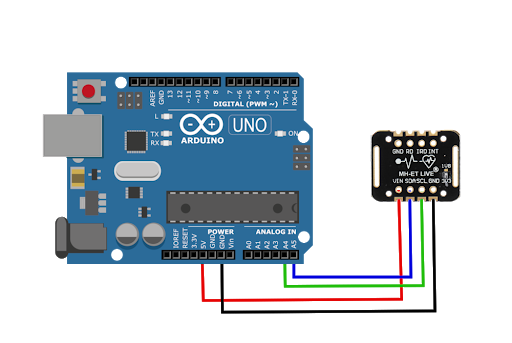
Max30102 Basic Setup
Max30102 Basic Setup
Comments
Only logged in users can leave comments