Devices & Components
1
Arduino® UNO™ Q 2GB
Software & Tools
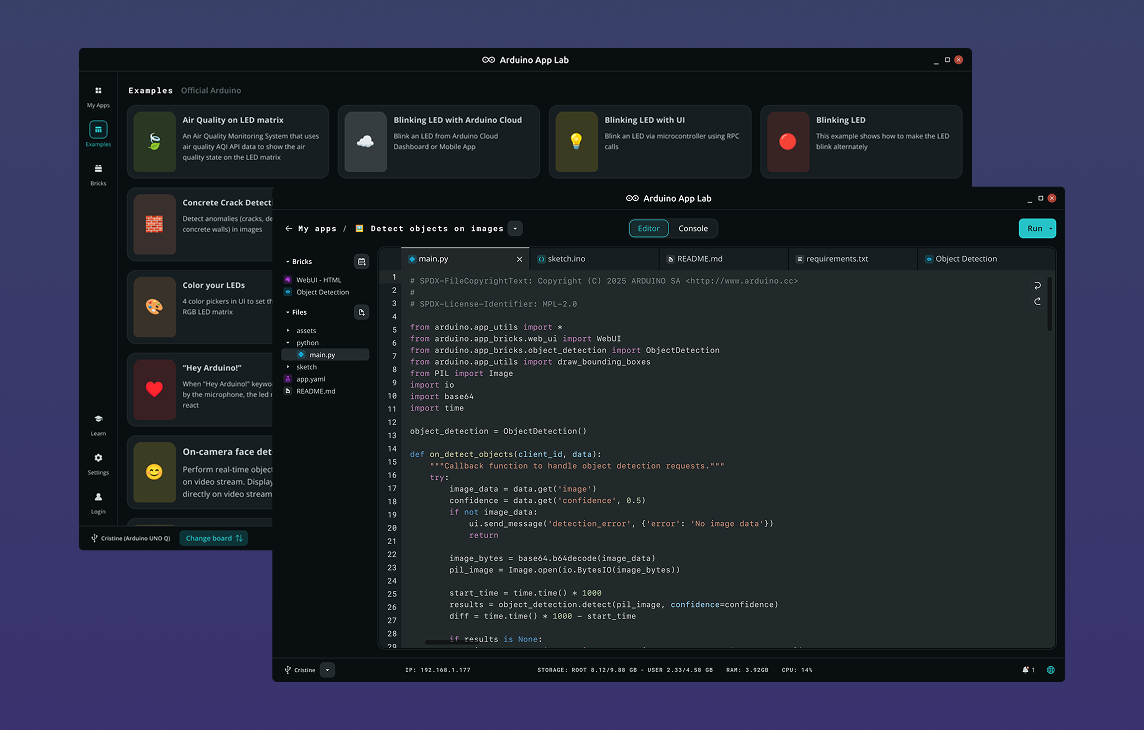
Arduino App Lab
Project description
Code
main
python
The main Python file to interface with Llama
1"""
2Termi3 - Python Script
3Cameron Coward
4cameroncoward.com
59/24/2026
6"""
7import http.client
8import json
9import re
10import socket
11import threading
12
13from arduino.app_utils import *  # noqa: F401,F403  (Bridge, App)
14
15# The llama-server runs as a systemd service on the HOST (bound to 0.0.0.0:8080).
16# This Python app runs inside an App Lab Docker container, so "127.0.0.1" is the
17# container's own loopback — NOT the host. We must reach the host via the Docker
18# gateway. Try the standard host aliases / gateway IPs in order and pick the
19# first that resolves+connects.
20LLM_PORT = 8080
21_HOST_CANDIDATES = [
22    "host.docker.internal",  # Docker's standard host alias (if enabled)
23    "172.19.0.1",            # termi3_default network gateway (observed)
24    "172.17.0.1",            # default docker0 bridge gateway (fallback)
25    "127.0.0.1",             # last resort (works only if not containerized)
26]
27
28
29def _pick_llm_host() -> str:
30    for host in _HOST_CANDIDATES:
31        try:
32            with socket.create_connection((host, LLM_PORT), timeout=2):
33                print(f"[termi3] llama-server reachable at {host}:{LLM_PORT}")
34                return host
35        except OSError:
36            continue
37    # Nothing reachable yet; default to the observed gateway and let requests
38    # surface the error (server may still be starting).
39    print("[termi3] WARNING: no llama-server host reachable yet; using gateway")
40    return "172.19.0.1"
41
42
43LLM_HOST = _pick_llm_host()
44LLM_PATH = "/v1/chat/completions"
45
46# Reuse a single HTTP connection across questions (avoids a fresh TCP handshake
47# per request). Guarded by a lock since Bridge calls may arrive on a thread.
48_conn_lock = threading.Lock()
49_conn = None
50
51
52def _get_conn():
53    global _conn
54    if _conn is None:
55        _conn = http.client.HTTPConnection(LLM_HOST, LLM_PORT, timeout=HTTP_TIMEOUT)
56    return _conn
57
58
59def _reset_conn():
60    global _conn
61    try:
62        if _conn is not None:
63            _conn.close()
64    except Exception:  # noqa: BLE001
65        pass
66    _conn = None
67
68# Concise/factual system prompt (no personality). Kept SHORT on purpose: fewer
69# prompt tokens = faster prompt processing and a smaller, more stable prefix
70# cache. Measured ~2.1-2.7s time-to-first-token vs ~5-10s with the long prompt.
71SYSTEM_PROMPT = (
72    "Answer the question concisely and factually in as few words as possible, "
73    "ideally one short sentence. No commentary or extra words."
74)
75
76MAX_TOKENS = 64
77TEMPERATURE = 0.3
78HTTP_TIMEOUT = 30  # seconds; the MCU-side Bridge timeout should exceed this
79
80# --- Output sanitization for the Silent 700 (uppercase ASCII printer) -------
81_MD = re.compile(r"[*_`#>]+")
82_UNICODE = {
83    "\u2019": "'", "\u2018": "'", "\u201c": '"', "\u201d": '"',
84    "\u2013": "-", "\u2014": "-", "\u2026": "...", "\u00a0": " ",
85}
86
87
88def sanitize(text: str) -> str:
89    text = _MD.sub("", text)
90    for k, v in _UNICODE.items():
91        text = text.replace(k, v)
92    text = text.encode("ascii", "ignore").decode("ascii")
93    # Collapse whitespace/newlines into single spaces (printer handles CR/LF
94    # via the MCU; the answer body should be one clean line).
95    text = " ".join(text.split())
96    return text.strip()
97
98
99def _query_llm(question: str) -> str:
100    body = {
101        "messages": [
102            {"role": "system", "content": SYSTEM_PROMPT},
103            {"role": "user", "content": question},
104        ],
105        "max_tokens": MAX_TOKENS,
106        "temperature": TEMPERATURE,
107        "cache_prompt": True,
108    }
109    data = json.dumps(body).encode()
110    headers = {"Content-Type": "application/json"}
111
112    with _conn_lock:
113        # One retry: if the persisted connection went stale, reset and redo.
114        for attempt in (1, 2):
115            try:
116                conn = _get_conn()
117                conn.request("POST", LLM_PATH, body=data, headers=headers)
118                resp = conn.getresponse()
119                raw = resp.read()
120                payload = json.loads(raw)
121                return payload["choices"][0]["message"]["content"]
122            except (http.client.HTTPException, OSError):
123                _reset_conn()
124                if attempt == 2:
125                    raise
126
127
128def ask(question: str) -> str:
129    """Called by the MCU over the Bridge. Returns a printable answer line."""
130    q = (question or "").strip()
131    if not q:
132        return "NO QUESTION RECEIVED."
133    try:
134        raw = _query_llm(q)
135        answer = sanitize(raw)
136        if not answer:
137            answer = "NO ANSWER."
138        print(f"[termi3] Q: {q!r} -> A: {answer!r}")  # App Lab console log
139        return answer
140    except Exception as exc:  # noqa: BLE001
141        print(f"[termi3] error: {exc}")
142        return "SORRY, MY BRAIN IS OFFLINE."
143
144
145def _llm_health_ok() -> bool:
146    """True if llama-server answers /health with 200."""
147    try:
148        with _conn_lock:
149            conn = _get_conn()
150            conn.request("GET", "/health")
151            resp = conn.getresponse()
152            resp.read()
153            return resp.status == 200
154    except (http.client.HTTPException, OSError):
155        _reset_conn()
156        return False
157
158
159def _warm_cache() -> None:
160    """Prime the llama-server prefix cache with our exact system prompt so the
161    first REAL question gets the fast (~2s) path instead of a cold (~10s) one.
162    """
163    try:
164        _query_llm("ping")
165        print("[termi3] prefix cache warmed")
166    except Exception as exc:  # noqa: BLE001
167        print(f"[termi3] warm-up skipped: {exc}")
168
169
170_warmed = False
171
172
173def is_ready() -> bool:
174    """MCU polls this at startup to know Python is up.
175
176    On a cold boot the llama-server (separate systemd service) may still be
177    loading its model. To make the FIRST question reliable, we don't report
178    ready until the LLM answers /health, then we warm the cache once.
179    The MCU keeps polling, so returning False just makes it wait.
180    """
181    global _warmed
182    if _warmed:
183        return True
184    if not _llm_health_ok():
185        return False          # LLM not up yet; MCU will poll again
186    _warmed = True
187    _warm_cache()
188    return True
189
190
191# Register functions the MCU can call.
192Bridge.provide("ask", ask)          # noqa: F405
193Bridge.provide("is_ready", is_ready)  # noqa: F405
194
195
196def loop():
197    # Nothing to do in the main loop; all work is driven by MCU calls.
198    import time
199    time.sleep(1)
200
201
202App.run(user_loop=loop)  # noqa: F405
sketch
cpp
The main Arduino sketch
1/*
2 *  """
3 *  Termi3 - Python Script
4 *  Cameron Coward
5 *  cameroncoward.com
6 *  9/24/2026
7 *  """
8 *
9 *   1. Print "ASK TERMI3: "                (bit-bang TX)
10 *   2. Read keystrokes until CR            (bit-bang RX -> line buffer)
11 *   3. Bridge.call("ask", question)        (blocks for the answer)
12 *   4. Print "TERMI3: " + answer           (bit-bang TX)
13 *   5. Loop
14 *
15 * serial config (Phase 3): A0=TX, A1=RX, 300 baud (BIT_US=3333),
16 * 7 data bits, odd parity, 1 stop, TX_INVERT=false / RX idle HIGH.
17 * Terminal switches: HIGH SPEED, HALF DUPLEX, ON LINE.
18 */
19
20#include <Arduino_RouterBridge.h>
21#include <Arduino_LED_Matrix.h>
22
23// ---------------- Status LED matrix (UNO Q, 8x13) ----------------
24// Three status icons show where the loop is, set once at each boundary
25// (never refreshed in loop()). The firmware refresh IRQ keeps the frame lit.
26// NOTE: that refresh IRQ runs during bit-bang serial. If it ever jitters the
27// 3.3ms/bit timing (corrupt chars), matrix.end() disables it as a fallback.
28Arduino_LED_Matrix matrix;
29
30// 8 rows x 13 cols, row-major, 1 = LED on. setGrayscaleBits(1) -> on/off.
31
32// "?" — waiting for a question
33const uint8_t ICON_WAIT[104] = {
34  0,0,0,0,1,1,1,1,1,0,0,0,0,
35  0,0,0,1,1,0,0,0,1,1,0,0,0,
36  0,0,0,0,0,0,0,0,1,1,0,0,0,
37  0,0,0,0,0,0,0,1,1,0,0,0,0,
38  0,0,0,0,0,0,1,1,0,0,0,0,0,
39  0,0,0,0,0,0,1,1,0,0,0,0,0,
40  0,0,0,0,0,0,0,0,0,0,0,0,0,
41  0,0,0,0,0,0,1,1,0,0,0,0,0
42};
43
44// hourglass — processing (waiting on the LLM answer)
45const uint8_t ICON_PROC[104] = {
46  0,0,0,1,1,1,1,1,1,1,0,0,0,
47  0,0,0,0,1,1,1,1,1,0,0,0,0,
48  0,0,0,0,0,1,1,1,0,0,0,0,0,
49  0,0,0,0,0,0,1,0,0,0,0,0,0,
50  0,0,0,0,0,0,1,0,0,0,0,0,0,
51  0,0,0,0,0,1,1,1,0,0,0,0,0,
52  0,0,0,0,1,1,1,1,1,0,0,0,0,
53  0,0,0,1,1,1,1,1,1,1,0,0,0
54};
55
56// speaker — responding (printing the answer)
57const uint8_t ICON_RESP[104] = {
58  0,0,0,0,0,1,0,0,0,0,0,0,0,
59  0,0,0,0,1,1,0,0,1,0,0,0,0,
60  0,0,1,1,1,1,0,1,0,1,0,0,0,
61  0,0,1,1,1,1,0,1,0,1,0,1,0,
62  0,0,1,1,1,1,0,1,0,1,0,1,0,
63  0,0,1,1,1,1,0,1,0,1,0,0,0,
64  0,0,0,0,1,1,0,0,1,0,0,0,0,
65  0,0,0,0,0,1,0,0,0,0,0,0,0
66};
67
68// A0/A1 (STM32U585 PA4/PA5, aliased D14/D15) are full digital GPIO — the
69// bit-bang is pure polled digitalRead/Write, so no pin-specific peripheral is
70// needed. NOTE: A0/A1 are NOT 5V tolerant; the MAX3232 runs at 3.3V so R1OUT
71// swings 0-3.3V. Keep the 5V connect-detect line (DA-15 pin 11) away from them.
72const int PIN_TX = A0;
73const int PIN_RX = A1;
74const int BIT_US = 3333;
75const int HALF_BIT_US = 1666;
76const bool TX_INVERT = false;
77const bool RX_IDLE_HIGH = true;
78
79const int  MAX_Q = 200;         // max question length
80
81// ---------------- TX (confirmed) ----------------
82inline void txBit(bool level) {
83  digitalWrite(PIN_TX, TX_INVERT ? !level : level);
84}
85void sendChar(char c) {
86  uint8_t data = (uint8_t)c & 0x7F;
87  txBit(false); delayMicroseconds(BIT_US);           // start
88  uint8_t ones = 0;
89  for (int i = 0; i < 7; i++) {
90    bool b = (data >> i) & 0x01; if (b) ones++;
91    txBit(b); delayMicroseconds(BIT_US);
92  }
93  txBit(ones % 2 == 0); delayMicroseconds(BIT_US);   // odd parity
94  txBit(true); delayMicroseconds(BIT_US);            // stop
95}
96void sendString(const char *s) { while (*s) sendChar(*s++); }
97void sendString(const String &s) {
98  for (unsigned i = 0; i < s.length(); i++) sendChar(s[i]);
99}
100void newline() { sendChar('\r'); sendChar('\n'); }
101// Advance the paper n lines (CR+LF each — bare CR would not feed the paper).
102void feedLines(int n) { while (n-- > 0) newline(); }
103
104// ---------------- RX (confirmed) ----------------
105inline bool rxLevel() {
106  bool high = (digitalRead(PIN_RX) == HIGH);
107  return RX_IDLE_HIGH ? high : !high;
108}
109// Blocking read of one char. Returns -1 on framing glitch.
110int receiveChar() {
111  while (rxLevel() == true) { /* idle */ }
112  delayMicroseconds(HALF_BIT_US);
113  if (rxLevel() != false) return -1;                 // false start
114  delayMicroseconds(BIT_US);
115  uint8_t data = 0;
116  for (int i = 0; i < 7; i++) {
117    if (rxLevel()) data |= (1 << i);
118    delayMicroseconds(BIT_US);
119  }
120  delayMicroseconds(BIT_US);   // past parity
121  return data & 0x7F;
122}
123
124// Read a full line until CR (0x0D) or LF, into buf. Returns length.
125// Uppercases letters (terminal is uppercase anyway; keeps things clean).
126int readLine(char *buf, int maxlen) {
127  int n = 0;
128  for (;;) {
129    int c = receiveChar();
130    if (c < 0) continue;                 // ignore framing glitches
131    if (c == '\r' || c == '\n') break;   // end of question
132    if (c == 8 || c == 127) {            // backspace/delete
133      if (n > 0) n--;
134      continue;
135    }
136    if (n < maxlen - 1 && c >= 32) {     // printable
137      buf[n++] = (char)c;
138    }
139  }
140  buf[n] = '\0';
141  return n;
142}
143
144// ---------------- App flow ----------------
145char question[MAX_Q];
146
147void printPrompt() {
148  newline();
149  sendString("ASK TERMI3: ");
150}
151
152void setup() {
153  pinMode(PIN_TX, OUTPUT);
154  txBit(true);                 // idle mark
155  pinMode(PIN_RX, INPUT);
156
157  matrix.begin();              // starts firmware refresh IRQ
158  matrix.setGrayscaleBits(1);  // 1 bit -> on/off
159  matrix.draw(ICON_PROC);      // "processing" while warming up
160
161  Bridge.begin();              // ~2s, blocking
162  Monitor.begin(115200);       // debug to App Lab console
163
164  // Wait until the Python side AND the local LLM are ready. is_ready() only
165  // returns true once llama-server answers /health, so on a cold boot this
166  // loop waits out the model-load time. Wait indefinitely (conference: the
167  // board is powered on and must self-heal, never give up).
168  bool ready = false;
169  unsigned long lastDot = 0;
170  while (!ready) {
171    Bridge.call("is_ready").result(ready);
172    if (!ready) {
173      // Print a slow row of dots so the paper shows it's warming up, not dead.
174      unsigned long now = millis();
175      if (now - lastDot > 3000) { sendChar('.'); lastDot = now; }
176      delay(200);
177    }
178  }
179
180  delay(300);
181  newline();
182  // Startup banner (branded prompt, per on-paper interaction design).
183  sendString("TERMI3 - A TYPEWRITER THAT THINKS");
184  newline();
185
186  matrix.draw(ICON_WAIT);      // ready, waiting for a question
187}
188
189void loop() {
190  matrix.draw(ICON_WAIT);                // waiting for a question
191  printPrompt();
192
193  int len = readLine(question, MAX_Q);
194  if (len == 0) return;                  // empty line -> re-prompt
195
196  matrix.draw(ICON_PROC);                // CR received -> processing
197
198  // Roll the paper up so the user can read back what they just typed.
199  feedLines(4);
200
201  // Static "thinking" marker. Printed BEFORE the blocking Bridge call, so it
202  // appears the moment the question is accepted. This is an ACKNOWLEDGEMENT,
203  // not a progress bar: at the conference many users couldn't tell whether
204  // their question had been received. A timed/animated indicator isn't
205  // possible here anyway — Bridge.call().result() blocks, so loop() gets no
206  // chance to print while waiting (see project memory: no concurrency, to
207  // protect bit-bang timing).
208  sendString("...");
209
210  // Ask Python (which queries the local LLM). Blocks for the answer.
211  // NOTE: using the plain .result() form (confirmed by docs). Timeout is
212  // handled Python-side (urllib 30s). If the default Bridge timeout proves
213  // too short for a cold first answer, we'll add MCU-side timeout config.
214  String answer;
215  bool ok = Bridge.call("ask", String(question)).result(answer);
216
217  feedLines(2);                          // separate the marker from the answer
218
219  matrix.draw(ICON_RESP);                // answer in hand -> responding
220  sendString("TERMI3: ");
221  if (ok && answer.length() > 0) {
222    sendString(answer);
223  } else {
224    sendString("SORRY, NO ANSWER.");
225  }
226
227  feedLines(4);                          // leave the answer visible above the platen
228}
Downloadable files
termi3_pcb
PCB files
termi3_pcb.zip
Comments
Only logged in users can leave comments